Sacred Postures of the Tantric Lovers: Yab Yum and the Art of Meeting in Stillness
In tantra, a posture is never a position. It is a meditation shaped by two bodies — a way of arranging breath, presence, and gaze so that something quieter can be felt between them.
There is a common misunderstanding that tantric practice is a catalogue of unusual positions. In truth, the sacred postures of tantra are something quite different — they are meditations. Ways of arranging two bodies so that breath, heart, and awareness can find one another without hurry.
The postures described in the old tantric texts were never designed to intensify sensation for its own sake. They were designed to slow two lovers down, to align the subtle energies of the body, and to allow presence itself to become the central experience. The most famous of them all is yab yum — but it is only one doorway among several.
Yab Yum — The Sacred Embrace
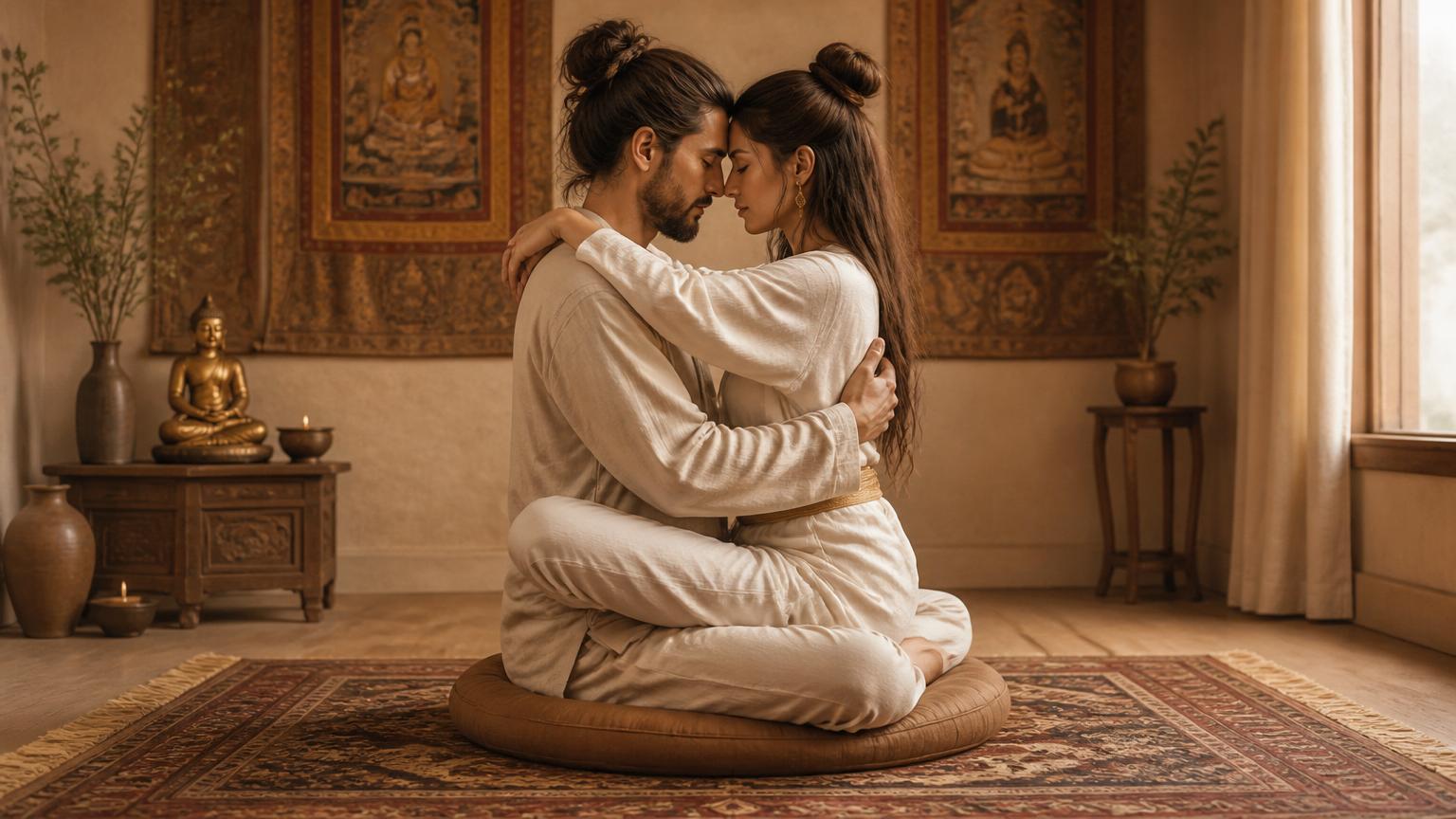
In Sanskrit, yab yum translates literally as 'father–mother', a name that speaks to its symbolism rather than its mechanics. It is the classical tantric embrace: one partner seated cross-legged, the other seated facing them, their legs gently wrapped around the first partner's waist. Chest meets chest. Hearts align. Foreheads can rest lightly together. The gaze softens. The breath, in time, begins to synchronise.
What makes yab yum sacred is not the shape itself, but what the shape makes possible. Held upright and facing, two people cannot hide from one another. There is no dominant partner and no passive one. Both are seated. Both are open. Both are equally present. The masculine and feminine — however each person carries them — meet as equals in a single, unbroken circle.
In this stillness, lovers are invited to do very little. To breathe. To gaze softly. To feel the rise and fall of the other's chest against their own. To allow the small movements of the body — a sway, a settling, a deeper breath — to arise naturally rather than be performed.
Yab yum is not a position to reach. It is a stillness to arrive in, and then to remain in long enough to be changed by.
Why Posture Matters in Tantra
Every posture in tantra carries an intention. Some open the heart. Some ground the body. Some invite surrender, others invite reverence. The shape of the body quietly instructs the mind — sit upright and the mind steadies, curl inward and the mind softens, meet face to face and the mind can no longer look away.
For two lovers, the chosen posture is a container. It defines how the energy between them can flow, how deeply they can see one another, and how much protection or openness the meeting will hold. Approached this way, even the simplest embrace becomes a practice.
The Heart-to-Heart Embrace
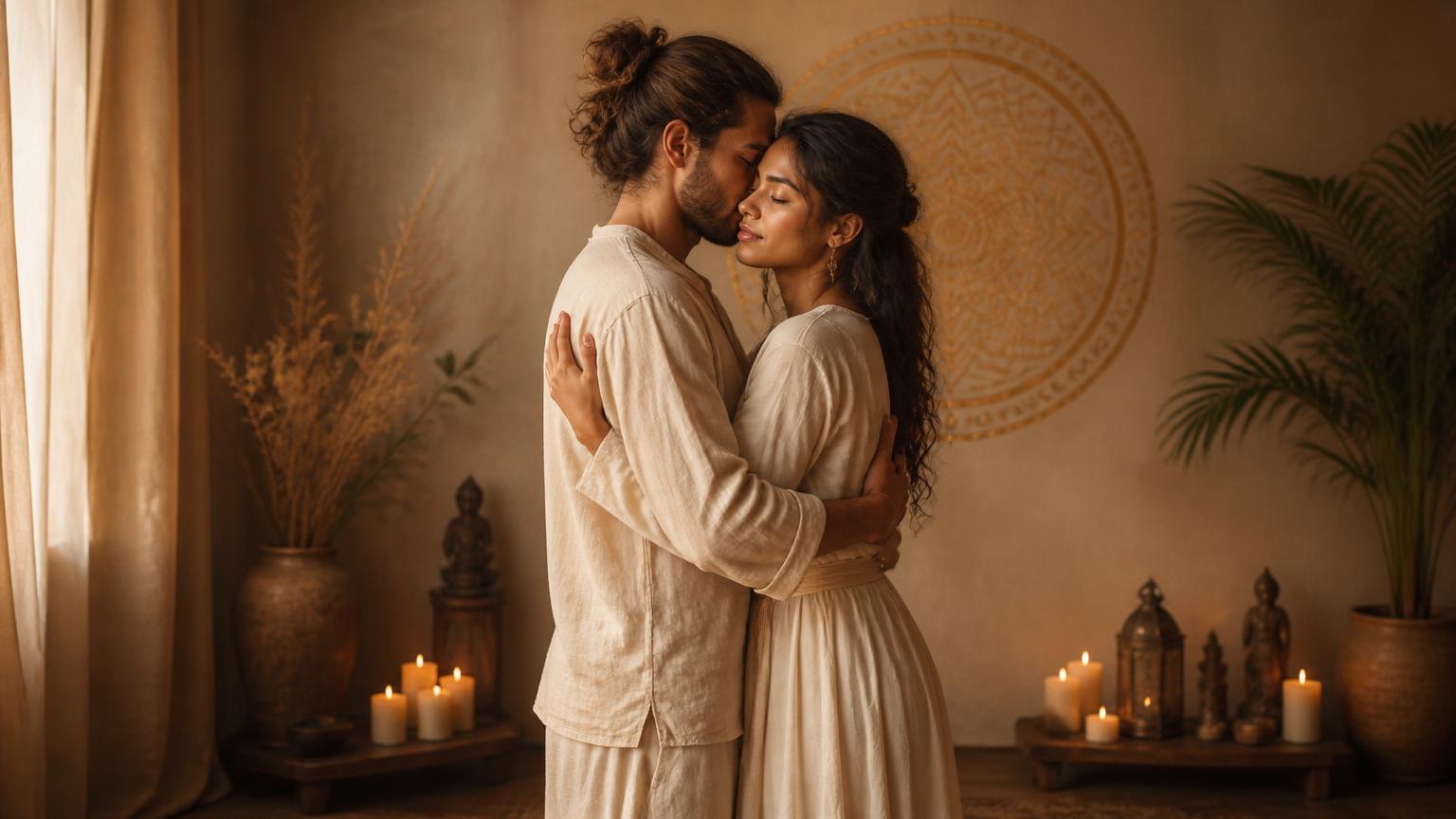
One of the gentlest tantric postures is the standing or seated heart-to-heart embrace. The two partners stand or sit facing each other, wrap their arms around one another, and rest their right cheeks softly together — so that each person's heart is aligned with the other's.
The instruction is simple and demanding: remain there, in silence, for the length of many slow breaths. Feel the warmth of the other's chest. Notice the moment when the two heartbeats begin to soften towards one another. This posture is often the beginning of a longer tantric evening — a way of arriving, of setting down the outer world before anything else unfolds.
The Spoon — Rest as Practice
The spoon is a lying posture in which one partner rests behind the other, their body curving softly around them, one hand placed gently over the heart or the belly. It is not preparation for anything. It is the practice itself.
In this shape, the partner behind offers the quality of being held; the partner in front offers the quality of being received. Both are giving, both are receiving, and the exchange is complete in the stillness. Many lovers rediscover, in this simple posture, that safety and sensuality are not opposites — that the deepest tenderness often lives exactly where nothing is being asked.
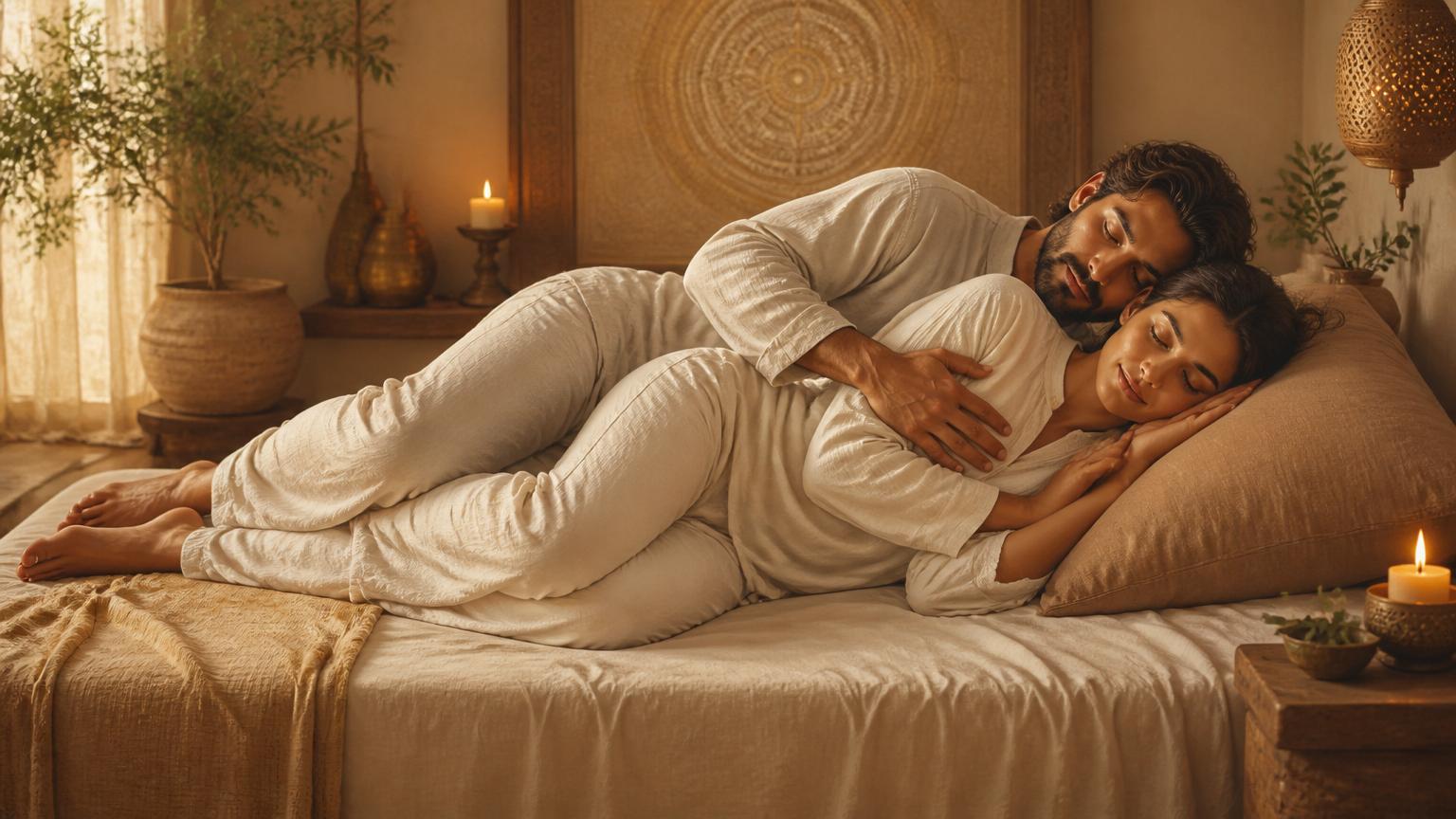
In tantra, being held is not the opposite of intimacy. It is one of its purest expressions.
The Reclining Meeting — Side by Side
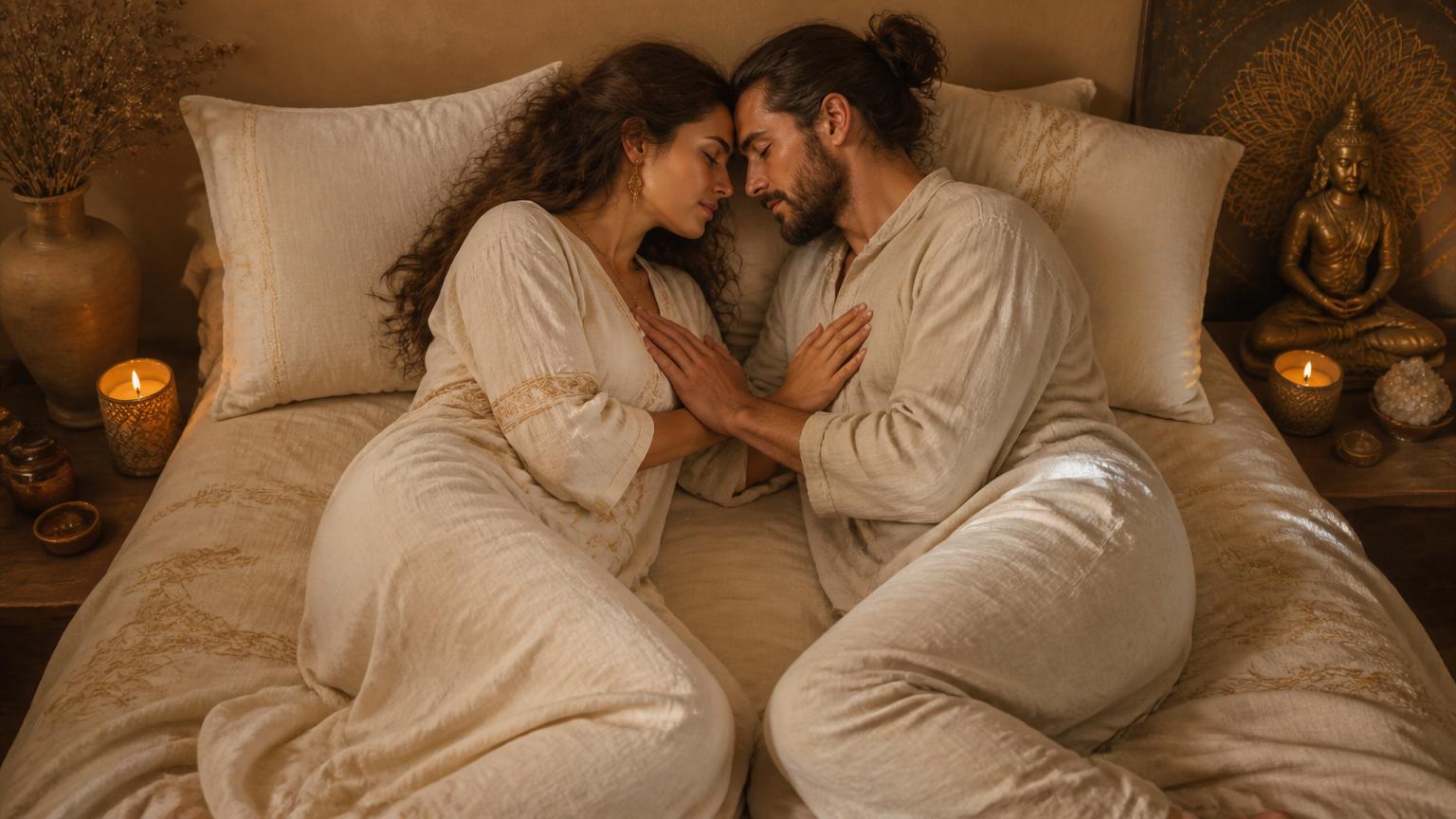
Two lovers may also lie on their sides, fully facing one another, their bodies close but not entwined. Foreheads may touch. One hand may rest on the other's heart, the other over their own — a small circuit of attention drawn between them.
This posture is one of the most honest in the tantric tradition. There is nowhere to look but into the eyes of the other. There is nothing to do but breathe. It teaches a rare lesson: that true intimacy is very often the willingness to remain, quietly, when there is no task to complete.
The Cradle — Deep Trust
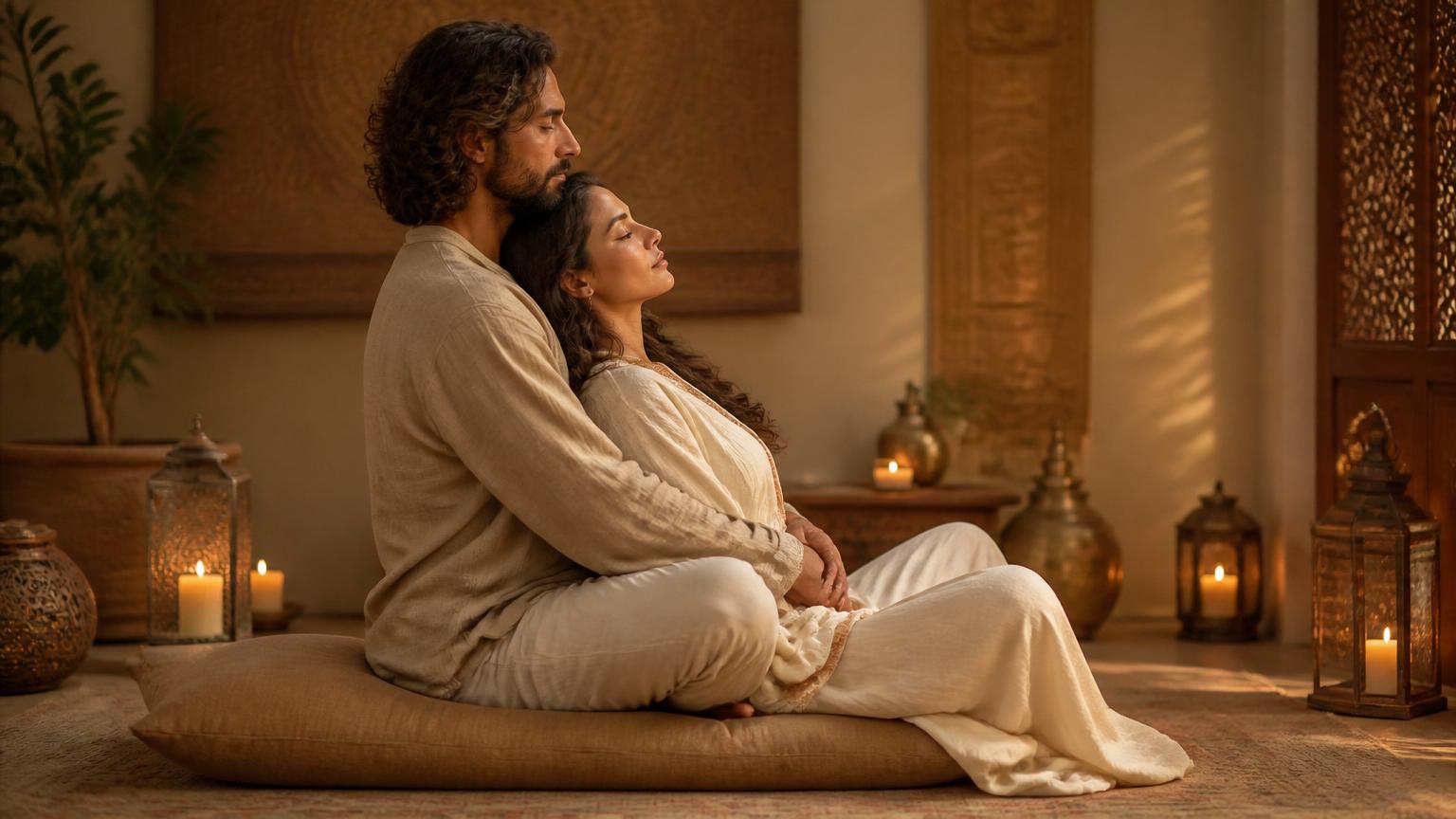
In the cradle posture, one partner sits with legs extended or gently crossed while the other rests back against their chest, held between the first partner's arms. The head can lean against the heart. The breath, held from behind, feels amplified — as if two nervous systems have quietly agreed to breathe as one.
This posture asks a great deal of trust from the one being held, and a great deal of steadiness from the one holding. It is often used when one partner needs to release something old — grief, tension, a memory the body has carried — and needs to feel, unmistakably, that they are not alone in the releasing.
The Role of Breath Across Every Posture
Whatever shape two lovers take, breath is the thread that turns a posture into a practice. In tantra, several breath patterns are traditional. Two partners may breathe together — inhaling and exhaling in unison — to deepen resonance. They may breathe in opposition — one inhaling as the other exhales — to create a circular exchange of energy, as though passing something warm and living between them. Or they may simply breathe naturally, side by side, letting their rhythms find one another without effort.
None of these is more advanced than the others. What matters is that the breath is noticed, honoured, and allowed to slow. The moment two people begin to breathe with awareness of one another, the space between them changes.
Eye Gazing — The Bridge Between Postures
Almost every seated tantric posture invites soft, sustained eye contact. Not the intense stare of confrontation, but a soft, receiving gaze — as if looking through the surface of the other person and resting quietly in what is behind their eyes.
Eye gazing can feel unfamiliar at first. Laughter often arises. Tears sometimes follow. Both are welcome. Held long enough, the gaze itself becomes a form of touch — a way of being met without a single word.
What These Postures Are Not
It bears saying clearly: these are not sexual positions in the modern sense. They are not techniques for intensifying arousal or reaching a particular outcome. They are meditative shapes, and their gift is not performance but presence.
A tantric posture may deepen naturally into more sensual intimacy, or it may remain exactly as it is for an entire evening. Both are complete. The tradition does not measure success by what happens next, but by the quality of what is felt inside the posture itself.
Preparing the Space
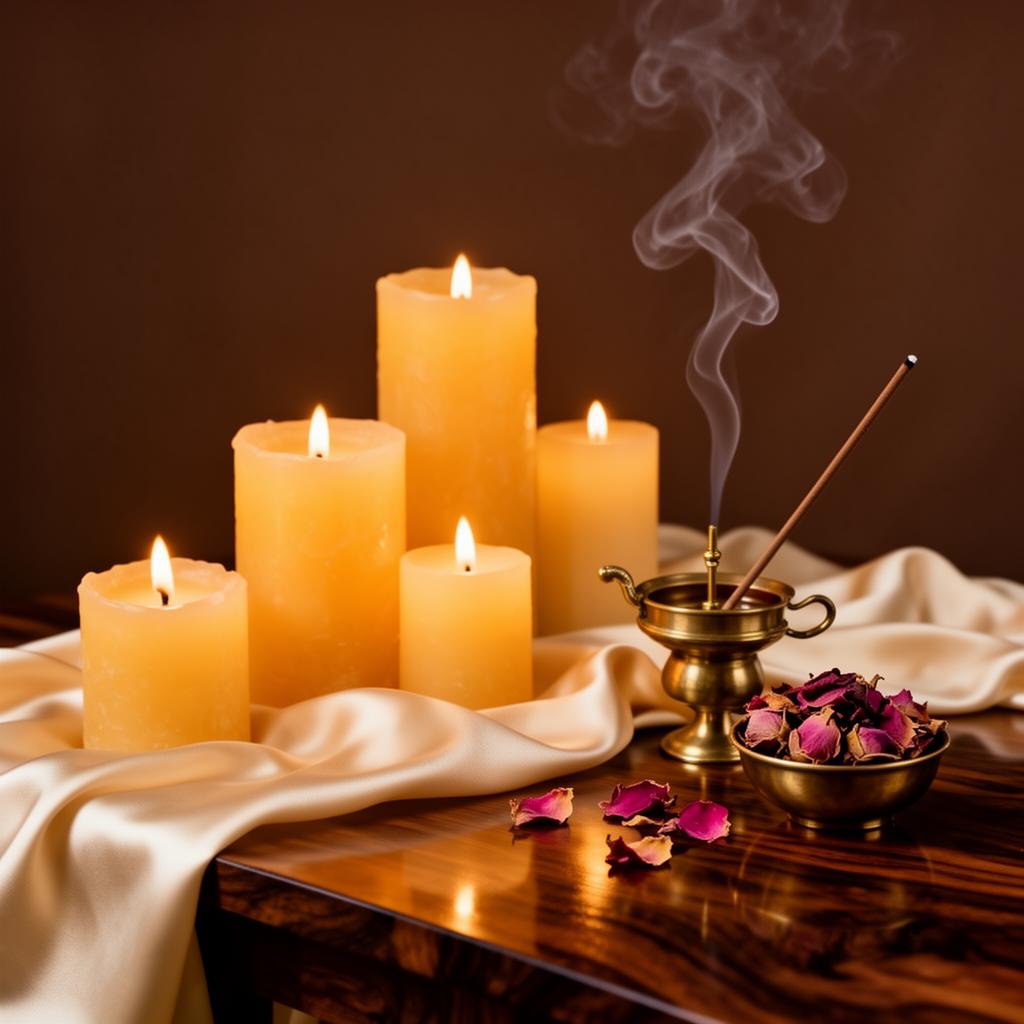
Because these postures ask so little of the body and so much of the attention, the surrounding space matters. Warm, dim light — candles rather than lamps where possible. A soft surface, cushions to support the seated postures so the spine can remain gently upright without strain. Silence, or very quiet music without lyrics. Phones set aside. Time set aside — a tantric evening cannot be rushed into forty-five minutes.
Some lovers begin with a shared cup of tea, a few words spoken about how they arrive, an intention offered aloud. These small rituals are not decorative. They mark the threshold between ordinary time and sacred time, and they help the nervous system understand that something different is now being invited.
Consent Lives Inside Every Posture
Even the gentlest of these embraces requires the same care as any deeper intimacy. Consent is offered before, and remains available throughout. Either partner may soften the posture, change it, pause it, or step out of it entirely at any moment — without explanation, without apology, and without any loss of tenderness in the room.
It is precisely this freedom that allows the postures to work. When the body knows it can leave at any time, it feels safe enough to stay.
The safety to stop is what allows two people to fully arrive.
Closing Reflection
The sacred postures of tantra are not exotic. They are, in their essence, ordinary human gestures — sitting together, holding one another, resting close, breathing near a heart that is not your own — approached with unusual patience and unusual reverence.
Yab yum, the heart-to-heart, the spoon, the reclining meeting, the cradle — each is a small architecture of belonging. Held gently, held slowly, and held often, they teach two lovers something that no technique can teach: that presence itself is the deepest form of intimacy, and that being fully met, in stillness, may be the rarest gift two people can offer one another.
Two bodies can arrange themselves in a hundred ways. Only presence turns an arrangement into an embrace.
If something here met you, perhaps it is time.
The sanctuary welcomes those who arrive with an open heart.
Begin an Enquiry